Who Is in the Driver’s Seat?
Dear Fellow Pilgrim,
I am learning so much about myself lately. Today, I learned that there are so many parts that make me me—and each one, at different moments, takes a turn in the driver’s seat. Some parts carry me down winding roads. Some find steadier paths. Some drive straight ahead. And sometimes the ride is smooth. Sometimes it is terribly bumpy. But I am beginning to see that it is not each part’s fault.
Each part was shaped by my life. Each part has been touched by what I have been through. Each part learned, somehow, to survive. There is the part that wants to please. The part that longs for comfort. The part that criticizes before anyone else can. The part that protects with anger. The part that manages, plans, organizes, and tries desperately to bring order to the chaos. The child within me, still tender and afraid. The creative part, full of longing and vision. The pilgrim part, trying to keep her face turned toward Christ. And then there is the Wise Mind—the quiet, centered place that listens to all the parts without letting one take over.
So I am trying to name them, these parts of me. I am trying to notice what brings each one forward, what makes them take the wheel, and what they are really needing. Because every need they carry is still a need within me. And I believe God wants those places healed. So instead of looking at them only with judgment—
“Why are you driving again, inner child? Grow up. Move on.”
“Why are you so needy?”
“Why are you so angry?”
“Why can’t you just be better?”—
I am trying to ask gentler questions.
Why are you here?
What have you been trying to protect?
What wound taught you to drive this way?
What role are you meant to have in my life?
Because they exist for a reason.
Not every part should have the wheel. But every part deserves to be heard. The critic may not be meant to condemn me, but perhaps to notice what needs repair. The protector may not be meant to wound others, but to remind me where safety and boundaries are needed. The child may not be meant to rule my life, but to show me where gentleness is still required. The comfort seeker may not be meant to beg for love, but to remind me that I was made to receive care. And the one who plans, manages, and strives—perhaps she is not meant to turn my life into a project, but to help me bring order without forgetting that I am a person.
This way of seeing myself is making room for compassion. Slowly, it is helping me love myself a little more. Even giving each part an image has tugged at my heart. Because now I can see them: struggling, striving, longing, needing, and slowly healing. And I wonder if this, too, is a kind of repentance—not the harsh kind that turns the soul against itself, but the tender kind that brings every hidden place into the light of Christ.
Perhaps healing begins when we stop dragging our wounded parts out of the driver’s seat with contempt, and instead invite them, gently, to sit beside us.
To listen.
To rest.
To be loved.
To let Christ touch what made them so afraid.
May we learn to ask, with mercy and truth: Who is driving now? And may we learn, little by little, to let the healed and healing self—the self held by God—take the wheel.
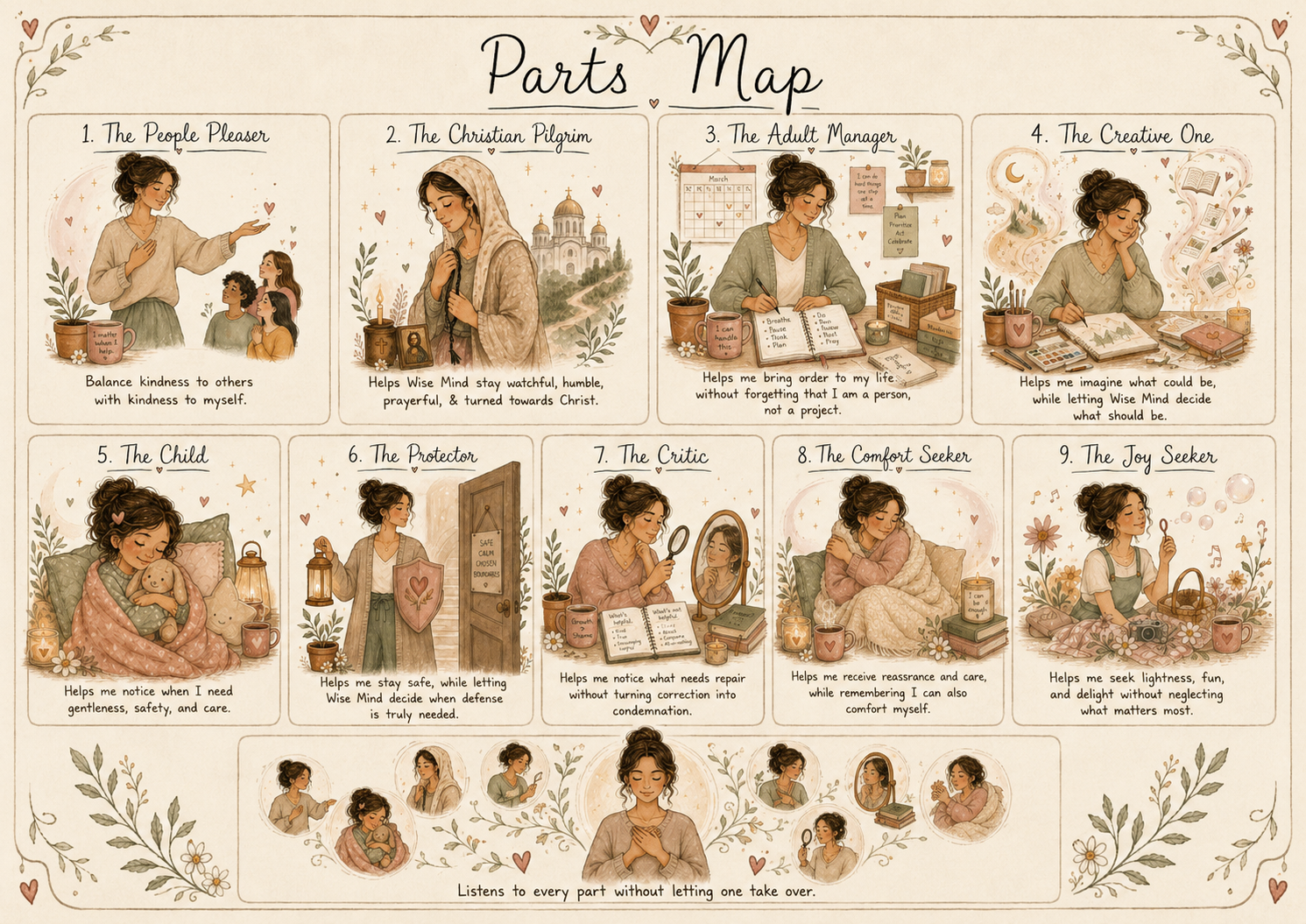
“The Parts of Me”
Not every part should hold the wheel, but every part deserves to be heard.